Review: Chagall – A Modern Master (Originally published in Hard Magazine)
By Katy Gregory.
Tuesday, July 30th, 2013.
Paris Through the Window – Mark Chagall
Following in the footsteps of Matisse and Klimt, another modern great in the canon of 20th century art history arrives at Tate Liverpool this summer. The largely underrepresented painter, lithographer, etcher and designer in question is Marc Chagall (1887-1985).
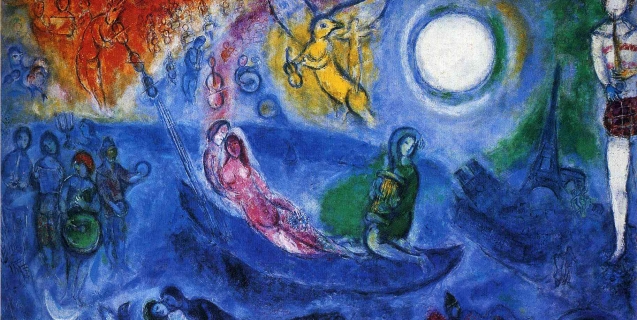
‘Chagall: Modern Master’ comprises work spanning 1911-1922 when the artist lived between Russia and Paris. The exhibition’s assertion of the Russian-born artist being a “modern master” has sparked quite a debate in the art world. Comprising of 60 of his most important works, the exhibition explores the stylistic relationship between Chagall, cubism, surrealism, and other modern pictorial modes. His whimsical figures inspired by his Jewish Russian past look, to say the least, unconventional alongside the styles of the avant-garde art movements he emulates.
In the first major UK presentation of his work for 15 years, Tate Liverpool offers an insight into the artists’ visual language with a chronological arrangement of paintings and drawings. The first of these we are introduced to is the playful self -portrait (Head with Nimbus) (1911), part of an experimental period before he finds his feet in some unique works. Self -portrait (Head with Nimbus) directly follows the conventions of neo-primitivism with its raw energy, rapid brushstrokes, and thick impasto, a style adopted by many of his contemporaries including Picasso.
However, after Chagall’s experimentation period in which he trialled many other modernist styles, the exhibition gathers speed and we see work from his brief but significant three years in Paris. It was at the 1911 Salon des Independents that cubism made its public debut and it is clear looking at his work from around this period and beyond that he was inspired by this exhibition; A marriage of wild planes of colour and the more conventional pictorial language of cubism can be seen in such works as Still Life from 1911. It is clear from this that Chagall made his mark on the avant-garde.
The exhibition continues to show the artist’s progression in his journey from his first artistic instruction in St Petersburg. In Paris, he eventually combines elements of cubism and surrealism with nostalgic figures inspired by his childhood. In ‘Paris through the Window’, he borrows industrial Parisian iconography from a close friend and fellow painter, Robert Delauney. Chagall said his traditional Hasidic background ‘left a profound mark’ on his work; A cat is painted with a human face and the Eiffel Tower is enveloped in a mysterious blanket of fog. He combines poetic expressions of his rural Russian past with the industrial and confusing modern metropolis of Paris. In this section of the exhibition, Tate Liverpool perfectly highlights Chagall’s individual modernist style, a discontinuity from the avant-garde with other works such as ‘I and the Village’ (1911).
The exhibition also explores the artists’ lesser known ventures. Monumentally scaled stage sets hang in a room mimicking the way they would have been installed in the theatre. These were produced by Chagall when he returned to Russia in 1917 as the Arts Commissioner of a theatre in Vitebsk.
Although some of his most iconic works do not feature, previously ignored aspects of Chagall’s artistic practice have been revealed by this important exhibition including his highly original amalgamation of styles. Some critics may question his contribution to the avant-garde but it is clear to those who visit this exhibition that Chagall was fearless in his artistic practice and liberated from the restraints of the overarching artistic movements he dabbled in. His hybrid works are as relevant today as they were all those years ago.
Source: www.hardzine.com
This story has been reproduced from www.hardzine.com. You can read the full story here.